
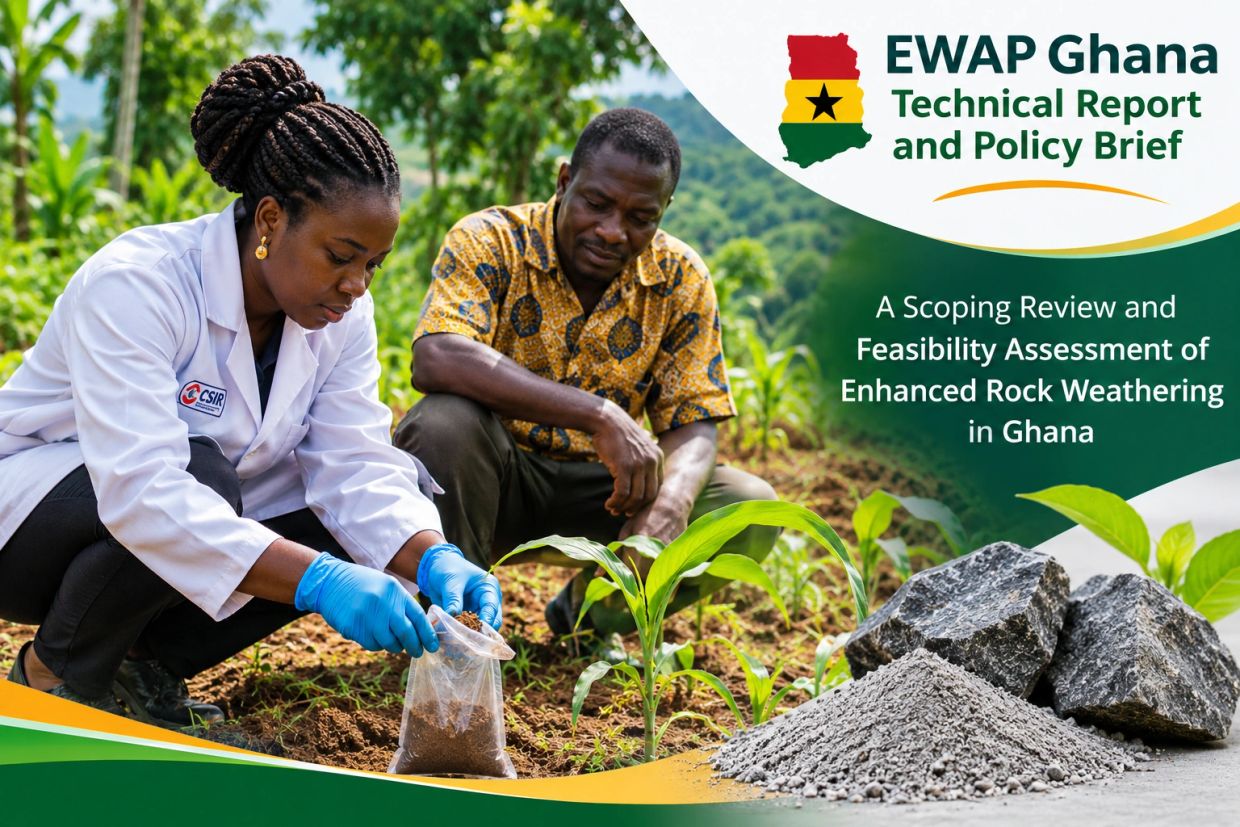
EWAP Ghana Technical Report and Policy Brief

A Scoping Review and Feasibility Assessment of Enhanced Rock Weathering in Ghana
Project status:
Funded | Ongoing – Report Development
Funding partner:
Oppenheimer Programme in African Landscape Systems (OPALS)
Geographic focus:
Ghana – Eastern Region, Birim North District
Research areas:
Enhanced Rock Weathering | Soil Health | Carbon Removal | Circular Economy | Farmer Participation | Climate Policy
About the Project
Additional Information
Ghana presents significant opportunities for enhanced rock weathering (ERW), particularly through its agricultural systems, mineral resources and growing interest in climate-smart agriculture. However, understanding whether ERW can be safely, effectively and economically implemented requires evidence grounded in Ghana's local conditions.
The EWAP Ghana Technical Report and Policy Brief is a funded research initiative under the Enhanced Weathering Africa Partnership (EWAP), supported by the Oppenheimer Programme in African Landscape Systems (OPALS).
Led by the University of Exeter in collaboration with the Council for Scientific and Industrial Research's Crops Research Institute (CSIR-CRI) and Soil Research Institute (CSIR-SRI) in Ghana, the project examines the feasibility of enhanced rock weathering within Ghana's agricultural, mining and climate-policy context.
The research combines a scoping review of existing scientific evidence with field-based investigations, farmer engagement, expert consultations and preliminary rock and soil sampling.
Its purpose is to generate locally relevant evidence and practical recommendations that can guide future research, responsible field trials, policy development and investment decisions.
Why This Project Matters
Enhanced rock weathering has the potential to improve agricultural soils while contributing to atmospheric carbon dioxide removal. Ghana's mining and quarrying sector also presents an opportunity to investigate whether suitable mineral by-products could be repurposed for agricultural use, supporting a circular economy.
However, the availability of rock materials does not automatically establish their suitability, safety or carbon removal potential.
The project therefore examines four interconnected dimensions of feasibility:
- Technical feasibility: Understanding rock characteristics, soil suitability, agricultural applications and carbon removal measurement.
- Economic feasibility: Assessing processing, transportation, application costs and potential agricultural benefits.
- Social feasibility: Exploring farmer awareness, acceptance, affordability, gender considerations and equitable participation.
- Environmental feasibility: Investigating potential risks associated with rock materials, soil and water quality, dust exposure and environmental safeguards.
Together, these dimensions provide a foundation for evaluating whether and how ERW could be responsibly advanced in Ghana.
