
ROCKS AFRICA
Predicting Enhanced Rock Weathering Across African Rock, Soil and Crop Combinations
Project status: In development | Seeking research funding and scientific partnerships
Geographic focus: Africa, with initial research engagement focused on Uganda and Tanzania
Research areas: Enhanced Rock Weathering | Soil Science | Rock Geochemistry | Carbon Removal | Crop Productivity | Predictive Modelling

About the Project
Additional Information
Enhanced rock weathering (ERW) offers a promising approach to removing atmospheric carbon dioxide while potentially improving soil health and agricultural productivity. However, its effectiveness depends on several interacting factors, including the type of rock applied, soil properties, climate conditions and crops being cultivated.
Much of the existing scientific evidence has been generated outside Africa, leaving important questions about how enhanced rock weathering might perform across the continent's diverse geological and agricultural environments.
ROCKS AFRICA is a proposed interdisciplinary research programme being developed through the Enhanced Weathering Africa Partnership (EWAP) to investigate how different African rocks, soils and crops interact to influence enhanced rock weathering outcomes.
The project aims to generate scientific evidence that can help predict where, how and under what conditions enhanced rock weathering could deliver effective carbon removal and agricultural benefits in Africa.
By combining laboratory experiments, soil and crop investigations, geochemical analysis and predictive modelling, ROCKS AFRICA seeks to strengthen the scientific foundations for future ERW field trials and responsible implementation.
Our Research Objectives
ROCKS AFRICA is being developed around four interconnected objectives.
1. Investigate African rock resources
Examine the mineralogical and chemical characteristics of selected locally available African rock materials to understand their suitability for enhanced weathering, including their potential reactivity and environmental risks.
2. Understand rock–soil–crop interactions
Investigate how different rock materials interact with contrasting agricultural soils and crops, including potential effects on soil chemistry, nutrient availability and plant growth.
3. Evaluate carbon removal potential
Assess weathering processes and associated carbon dioxide removal potential under controlled experimental conditions, while examining the factors that influence the reliability of carbon removal estimates.
4. Develop predictive tools for future field trials
Use experimental evidence and modelling to improve predictions of enhanced weathering performance across different rock, soil and crop combinations, helping inform the selection and design of future African field trials.

Research and Partnership Approach
ROCKS AFRICA is being developed around four interconnected objectives.
ROCKS AFRICA is being developed through an interdisciplinary collaboration involving expertise in soil science, geochemistry, agricultural systems, environmental sustainability and predictive modelling.
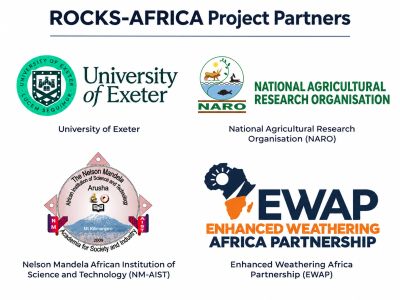
The proposed research draws on scientific expertise at the University of Exeter, including the Exeter Soil Carbon Exchange research facilities, alongside EWAP's existing African research relationships.
Initial research engagement is focused on Uganda and Tanzania, including opportunities for collaboration with the National Agricultural Research Organisation (NARO) in Uganda and the Nelson Mandela African Institution of Science and Technology (NM-AIST) in Tanzania.
The proposed research will initially prioritise controlled experiments to investigate selected rock–soil–crop combinations. This approach will help establish the scientific evidence needed to inform subsequent field investigations.
The wider ambition is to develop research methods and evidence that can be applied across additional African agricultural settings through future collaborations.
Specific experimental activities, institutional responsibilities and project arrangements will be confirmed as the research programme develops.
Potential Research and Practical Impacts
ROCKS AFRICA aims to contribute to:
- Stronger scientific evidence: Improving understanding of how African rock materials interact with agricultural soils and crops.
- More informed field-trial design: Identifying promising combinations and reducing uncertainty before larger-scale research and implementation.
- Reliable carbon removal assessment: Strengthening the evidence needed to evaluate enhanced weathering performance under different conditions.
- Agricultural sustainability: Investigating potential soil-health and crop-productivity benefits alongside environmental risks.
- African research capacity: Supporting collaboration, scientific knowledge exchange and locally relevant research.
- Responsible investment: Providing evidence to help researchers, governments and potential investors make better-informed decisions about future ERW activities.

Opportunities for Collaboration and Research Support
ROCKS AFRICA is currently in development, with research funding being pursued to support its proposed scientific activities.
EWAP welcomes engagement from universities, research institutions, soil scientists, geochemists, agronomists, geological surveys, quarry operators and organisations interested in advancing independent scientific evidence on enhanced rock weathering.
Opportunities for collaboration may include contributing scientific expertise, identifying suitable rock materials, sharing relevant geological or agricultural data, supporting laboratory investigations and participating in future research partnerships.
Financial support will be important for laboratory experiments, analytical equipment, research personnel, modelling and subsequent field investigations.
However, opportunities for scientific exchange, research collaboration and partnership development can also contribute to advancing the programme during its development stage.
